What To Know Before You Start Studying For The BCBA Exam
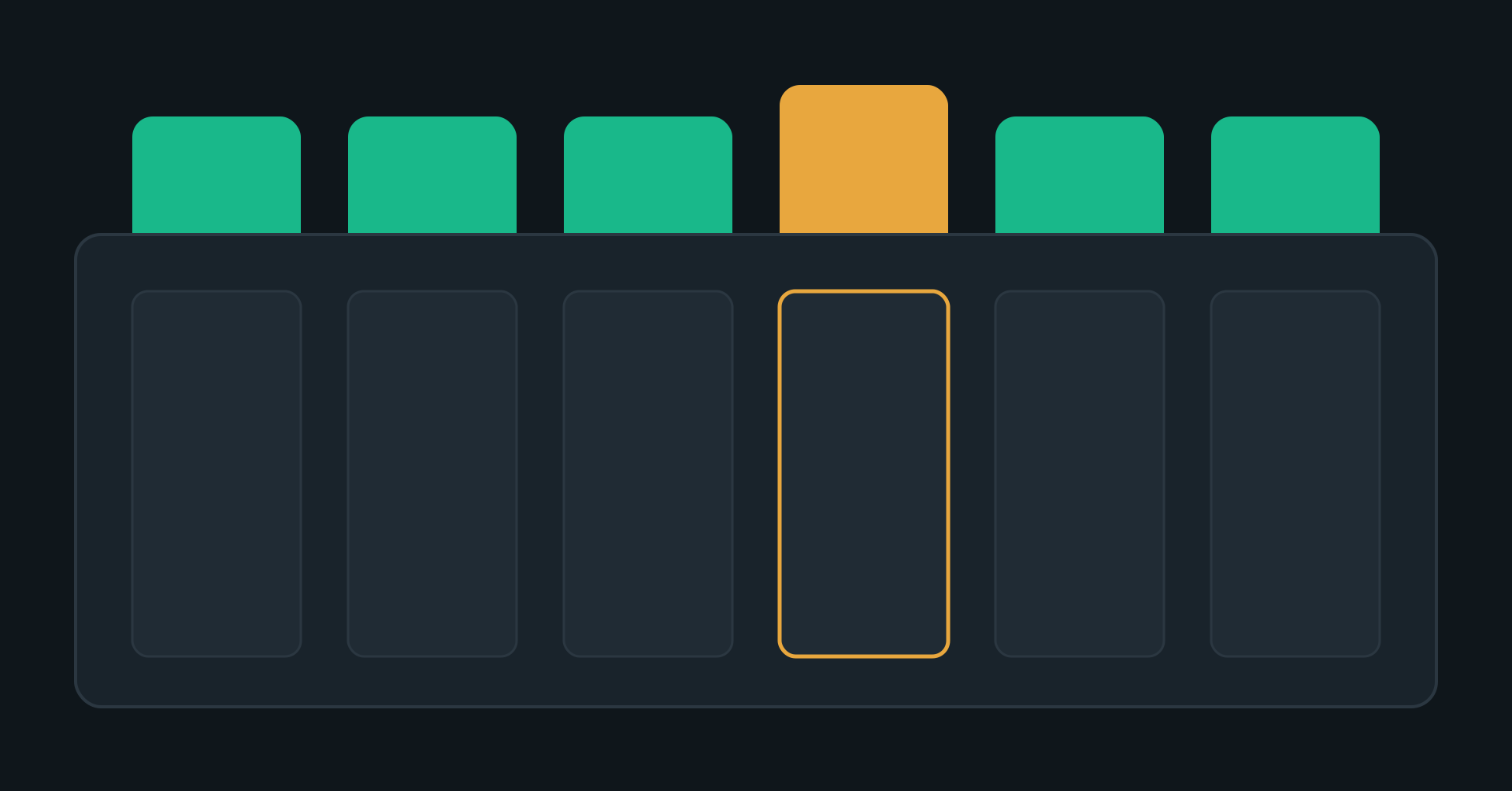
Most people start preparing for the BCBA exam by opening a textbook. That is a reasonable instinct and it is slightly too early, because a handful of facts about how the exam is built and scored change what a sensible study plan looks like.
Before you study, know these six things: the exam is 185 questions of which only 175 are scored, there is no fixed passing percentage because scores are scaled, you receive almost no feedback if you pass and a detailed breakdown if you fail, you have eight attempts inside a two-year window, the nine content areas carry very different weights, and the exam tests judgment on scenarios rather than recall of definitions. Each one has a consequence for how you prepare.
1. Ten of the questions do not count
The BCBA examination contains 175 scored questions and 10 unscored pilot questions, according to the BACB's Test Content Outline, and you get four hours for all 185. That four hours is seat time rather than question time — the BACB counts the terms and conditions, the navigation tutorial and the load-time prompt inside it. The pilot items are being tested for future use.
As is standard for pilot testing, they are not identified while you sit the exam.
Ten of the 185 do not count
One cell per question. Source: BACB Test Content Outline, 6th edition
- Scored question (175)
- Unscored pilot question (10)
The practical consequence is small but real: a question that feels strange or unusually hard may simply be an experimental one, and it may not count. That is not a reason to skip anything, but it is a reason not to let one baffling question derail the next twenty. Every candidate gets ten of them.
Try this: when a question feels wildly out of step with everything else, answer it, let it go, and move on. Do not spend five minutes proving something to yourself on a question that may not be scored.
2. There is no passing percentage
This is the most widely misunderstood thing about the exam, and you will find confident numbers all over the internet — "you need about 76%", "you can miss around 45". None of them come from the BACB.
The BACB sets the passing standard using the modified Angoff method, where subject-matter experts judge each form, and then scales the results so the standard is comparable across forms. In its own words, scaled scores are created when the number of questions answered correctly is "mathematically transformed so that the passing score equals a certain point on a scale". What reaches you, though, is pass or fail: the handbook says so plainly, and the BACB states just as plainly that it will not report the number of questions answered correctly or the overall percentage.
So the honest answer to "how many can I get wrong" is that nobody outside the BACB knows, including the people publishing numbers.
Try this: stop aiming at a percentage. Aim at being consistently solid across all nine areas, because that is what the scoring is designed to detect.
3. You get almost no feedback if you pass
Passing candidates receive notice that they passed. That is the whole report. Failing candidates receive a breakdown showing the percentage of questions answered correctly, and the total number of questions, within each primary content area.
That asymmetry is worth sitting with before you start. The only detailed, personalised information the system produces about your performance goes to people who did not pass. If you do end up retaking, that report is the most valuable thing you own — though the BACB attaches a caution worth heeding: the number of items per task is small, so treat the breakdown as a guide rather than a verdict, and do not study only the areas you got wrong, because that can cost you elsewhere.
It also means you cannot rely on the exam itself to tell you where you are weak beforehand. You have to generate that information yourself, from practice, before test day.
Try this: build a source of domain-level feedback into your preparation from week one, rather than hoping to discover your weak areas on the exam.
4. Your clock starts before you feel ready
Once your application is approved you enter a two-year authorization period, and you have eight attempts to pass inside it. After a failed attempt the retake application appears in your BACB account within 48 hours, and you can sit again 30 days from your last attempt. Results come back before you leave the testing centre.
Eight attempts sounds generous. It is, until you notice that each cycle costs at least a month and that the window is fixed regardless of what else is happening in your life. The candidates who run into trouble are usually not the ones who failed once; they are the ones who spent several attempts changing nothing in between.
Try this: work out your authorization end date now and write it somewhere you will see it. Plan backwards from that date rather than forwards from today.
5. The nine content areas are not equal
The Test Content Outline specifies how many scored questions come from each content area, and the spread is wider than most study plans reflect.
Scored questions per content area
175 scored questions across nine areas. Source: BACB Test Content Outline, 6th edition
| Area | Content area | Scored questions | Share of exam |
|---|---|---|---|
| G | Behavior-Change Procedures | 25 | 14% |
| B | Concepts and Principles | 24 | 14% |
| F | Behavior Assessment | 23 | 13% |
| E | Ethical and Professional Issues | 22 | 13% |
| C | Measurement, Data Display, and Interpretation | 21 | 12% |
| H | Selecting and Implementing Interventions | 20 | 11% |
| I | Personnel Supervision and Management | 19 | 11% |
| D | Experimental Design | 13 | 7% |
| A | Behaviorism and Philosophical Foundations | 8 | 5% |
Behavior-Change Procedures carries 25 scored questions. Behaviorism and Philosophical Foundations carries 8. If your study schedule gives each area a week, you are spending the same effort on a fifth of the exam as on an area worth three times more.
This is not an argument for ignoring the small areas. It is an argument for noticing that a week is not a unit of exam value, and for weighting your time roughly the way the exam weights its questions.
Try this: build your schedule in proportion to the scored-question counts above, then adjust for where you are weakest. Weighting first, weakness second.
6. It tests judgment, not recall
The exam presents situations and asks what you would do. Knowing the definition of a term is where preparation starts, not where it finishes — and the gap between those two things is a common reason well-prepared-feeling candidates are surprised.
This also appears to be getting harder rather than easier. First-time pass rates have fallen from 60% in 2021 to 51% in 2025. The BACB publishes those numbers without explaining them; the explanation usually offered by trainers is that the exam has moved further toward application and judgment. Whatever the cause, preparation built on memorising definitions is preparing for a version of the exam that is receding.
Try this: for every concept you learn, write a short scenario from your own fieldwork where it applies. If you cannot, you know the word rather than the concept.
So what do you actually do first?
Not read a textbook cover to cover. Find out where you stand across the nine areas, weight your plan by both the exam's weighting and your own gaps, and pick study methods that produce recall rather than familiarity — which is its own subject, and the one with the most research behind it.
Frequently asked questions
How many questions are on the BCBA exam?
185 in total: 175 scored questions and 10 unscored pilot questions, according to the BACB Test Content Outline. The pilot items are not identified while you are sitting the exam.
How long is the BCBA exam?
Four hours. The BACB counts the terms and conditions, the navigation tutorial and the load-time prompt inside that window, so it is total seat time rather than four hours of questions.
What score do you need to pass the BCBA exam?
There is no published passing percentage. The BACB sets the standard using the modified Angoff method and scales the results, and it does not report the number or percentage of questions answered correctly. What you receive is a pass or a fail.
What feedback do you get after the BCBA exam?
If you pass, only notice that you passed. If you fail, you receive a report showing the percentage of questions you answered correctly, and the total number of questions, within each primary content area.
How many times can you take the BCBA exam?
Eight attempts within the two-year authorization period that begins when your application is approved, with a 30-day wait between attempts.
Which BCBA content area has the most questions?
Behavior-Change Procedures, with 25 scored questions, or 14% of the exam. Concepts and Principles is close behind at 24. The smallest is Behaviorism and Philosophical Foundations at 8 questions, or 5%.
How long should I study before taking the BCBA exam?
Long enough to cover all nine areas in proportion to their weighting and to have tested yourself on each of them repeatedly. Research on spaced practice favours spreading preparation across months rather than compressing it into weeks.
Where to start
Take a diagnostic before you build a plan. Everything above is only useful once you know which of the nine areas you are actually weak in, and your instinct about that is not reliable enough to schedule around.
Before you build a study plan, find out where you actually stand. Beacon's free diagnostic scores you by content area, weighted the way the real exam is weighted, so your plan starts from evidence instead of a guess.
The research behind this
- BACB BCBA Test Content Outline (6th edition) — scored and pilot question counts, content area weights.
- BACB examination information — scoring method, scaled scores, results reporting, pass rates.
- BACB on continual testing — attempts, the 30-day wait and immediate results.
- BACB BCBA Handbook — the two-year authorization period.